
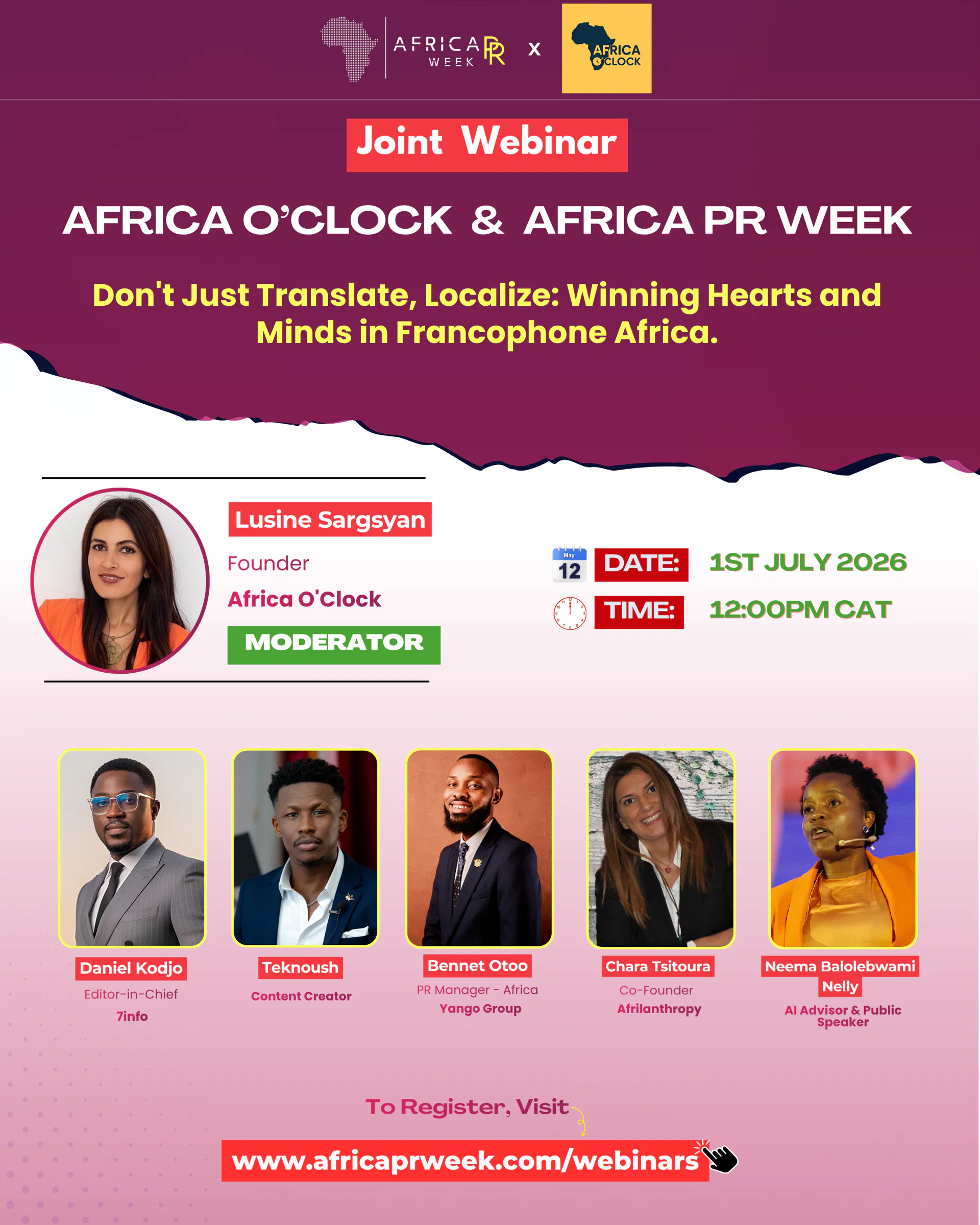
Africa Global PR Week and Africa O'clock brought together media, creator economy, corporate PR and institutional communications voices for a focused conversation on what international brands often miss when entering Francophone African markets.
The webinar, moderated by Lusine Sargsyan, Founder of Africa O'clock, addressed a simple but often underestimated question: is translating a campaign into French enough to connect with audiences in Abidjan, Dakar, Cotonou, Douala or Kinshasa?
The answer that emerged from the discussion was clear. Localization is not a final adjustment made after a campaign is approved. It is a strategic process that should begin at the earliest stage, with local journalists, PR professionals, content creators and market experts involved before messaging becomes fixed.
The panel featured Daniel Kodjo, journalist and Editor-in-Chief of 7info; Teknoush, also known as Mohamed Lamine Sibi, an Ivorian content creator with more than 5 million followers; Bennet Otoo, PR Manager Africa at Yango Group; and Chara Tsitoura, Director of Communications & Branding and Co-Founder of Afrilanthropy.
Local media as a driver of trust
Daniel Kodjo emphasized that local journalists are not only distribution channels for brand announcements. They help interpret, question and contextualize information for the public, which gives them a central role in building trust around a brand.
He noted that a press message becomes more credible when it reflects local realities, connects with the concerns of the audience and offers useful information beyond a corporate announcement. For international brands, this means understanding the local news agenda and involving media perspectives earlier, instead of approaching journalists only when coverage is needed.
Humour as a brand language
Teknoush brought the creator and audience perspective, highlighting the role of humour as one of the most powerful cultural bridges in Francophone Africa. His point was not that every brand must become informal, but that humour, when used with intelligence and authenticity, can make messages feel closer to real life.
He also underlined that creators should not be reduced to scripted amplifiers. Their value lies in their ability to understand tone, timing, local expressions and everyday situations. When brands give creators room to adapt, the message becomes more natural and more likely to resonate.
From market adaptation to local context
Bennet Otoo shared the corporate communications perspective of a brand operating across multiple African markets. He explained that localization is not about changing the name of a city in a campaign and assuming the message is ready.
For him, the work is deeper: each campaign must be adapted to the local context, consumer habits, media environment and cultural references of the market. A brand becomes more familiar to local audiences when it reflects the way people actually live, speak, move and make decisions.
Keeping a corporate tone while staying culturally aware
Chara Tsitoura added the institutional communications perspective, drawing on her experience across several African countries. She spoke about the need to make communication more human and locally grounded while maintaining a credible, corporate and professional tone.
This balance becomes especially important when organizations communicate on complex or sensitive topics such as gender, climate, governance, reform and development. The discussion showed that localization does not weaken institutional credibility. When done well, it strengthens clarity, relevance and trust.
Key takeaways
- Translation can make a message understandable, but localization makes it relevant.
- Journalists, PR experts, creators and local partners should be involved from phase one, not only after headquarters has approved the campaign.
- Strict scripts often prevent local partners from bringing the cultural value they were hired for.
- Humour can become a strong brand voice when it is rooted in local codes and handled with respect.
- Real localization adapts the context, examples, media angle, tone and cultural references, not only the words.
A platform for practical industry conversations
Closing the session, Lusine Sargsyan said she was pleased to provide a platform for a concise and practical discussion, where concrete issues were addressed instead of formal speeches. She noted that the value of the exchange came from hearing directly from people who work with audiences, media, institutions and brands across African markets.
She also stated that Africa O'clock intends to continue hosting conversations with industry leaders across different markets, with the aim of raising existing challenges, identifying where solutions stand and giving more visibility to Francophone African voices in global PR and communications discussions.
Through this webinar, Africa Global PR Week and Africa O'clock reaffirmed that localization is not a cosmetic communication step. It is a strategic requirement for any organization that wants to build trust, relevance and long-term reputation in Francophone Africa.